Mumbai residency reveals the rich tapestry of Indian embroidery
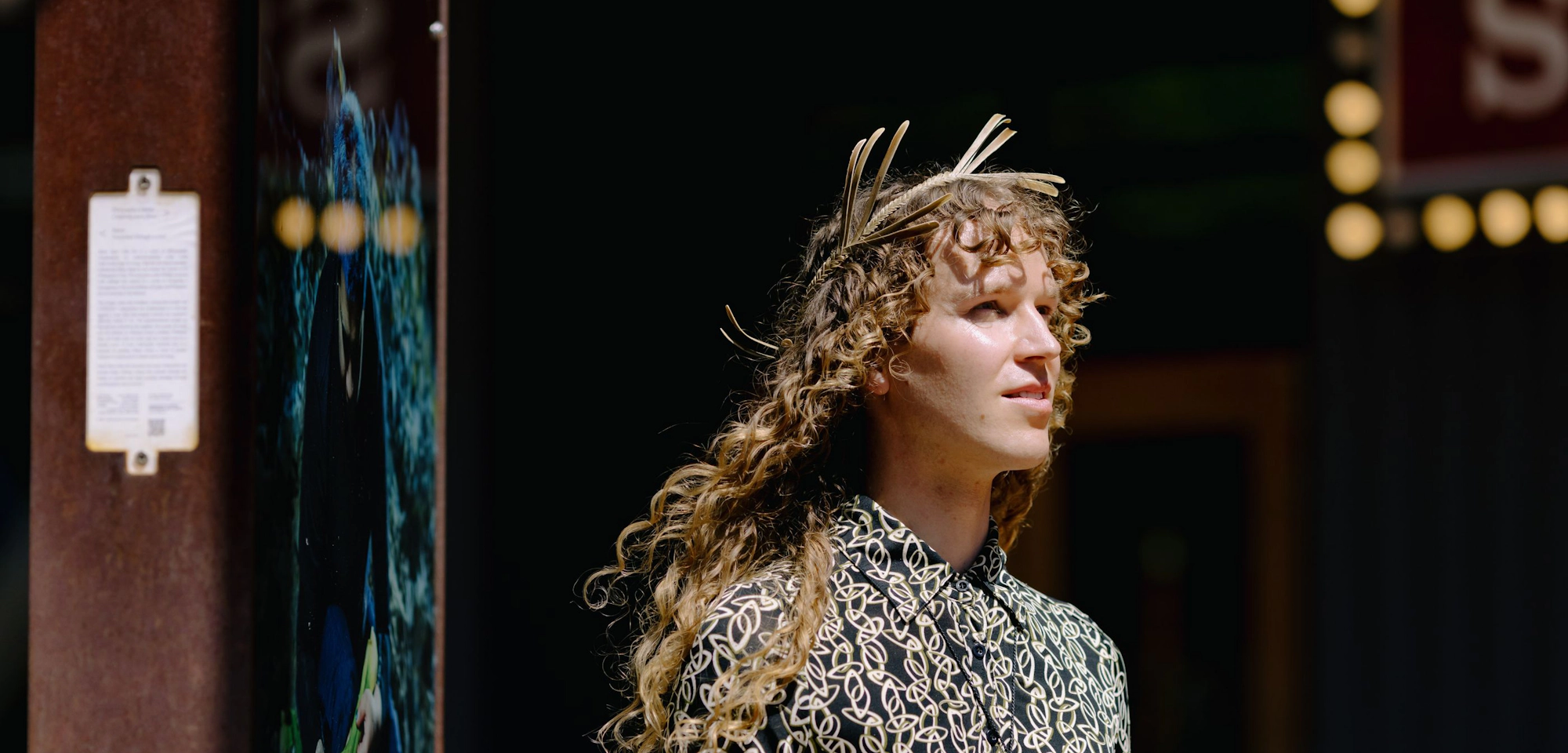
Paul McLachlan’s six-week residency in Mumbai marked a new direction in his practice, connecting his process-driven painting with the traditions of Indian embroidery. Working closely with local artisans, the residency offered an opportunity to build connections, learn advanced embroidery techniques, and develop new works that merge his painterly approach with traditional Indian craft. Supported by the Asia New Zealand Foundation’s Arts Experience Fund, the experience has fostered ongoing creative relationships and will culminate in a forthcoming exhibition in New Zealand.


Paul: "Mumbai is a city with a palpable upward trajectory, entering a period of urban development that is hard not to find energising."
The first stages of this project unfolded in a cold studio in Southland, New Zealand. Linen was sent over from the atelier [studio] in India, finely woven and pre-faced. I worked into it with impasto oil and acrylic stains, masking areas, building weight and movement across the surface, and adding fine ink lines to demarcate sections of my embroidery designs.
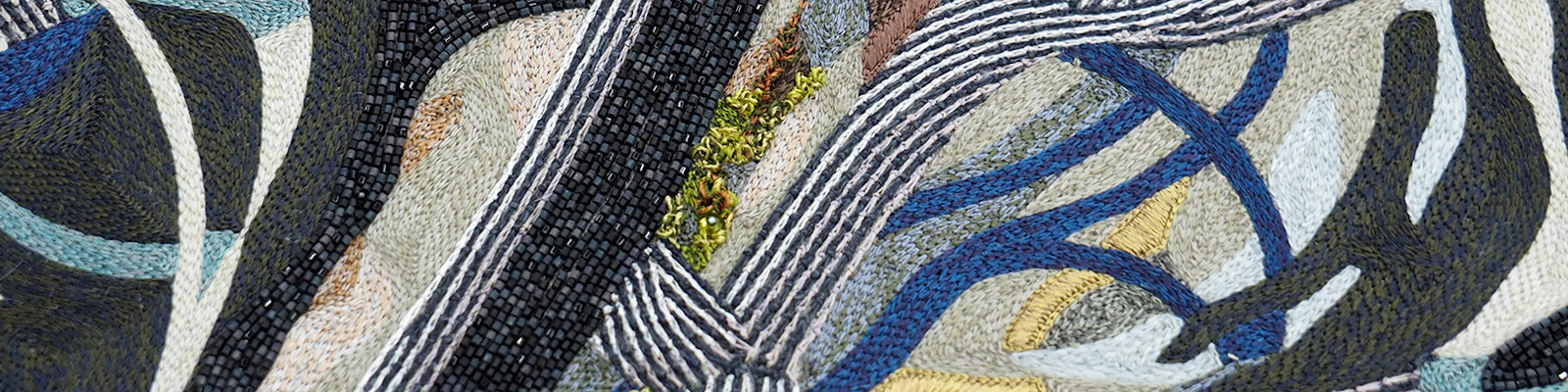
My practice has long drawn on processes adjacent to painting: engraving, print, mechanical weaving... Embroidery, however, introduced a distinct slowness and a kind of human-hand sensitivity that the new body of work requires. The half-completed artworks I packed to take to India represented a critical phase of the creative process where testing, uncertainty, and decision-making were still active.
The studio I worked with, 2M Ateliers in Mumbai, is a professional embroidery studio dedicated to championing Indian craft, led by Max Modesti. It sits within a broader lineage of Indian embroidery that continues to inform international couture and cross-cultural textile production. When I arrived at the studio, it felt like stepping into a cool oasis, in complete contrast to the fast and chaotic city outside. Inside, it was quiet, organised, and very clean.


Paul: "Being present in the studio rhythm allowed me to absorb the process..."
Mumbai is a city with a palpable upward trajectory, entering a period of urban development that is hard not to find energising. Most mornings began on the back of a motorbike, moving through early traffic before the city fully woke. I was told, “Indians are not for the mornings,” and the streets didn’t fully come alive until late morning. I stayed in different districts across the city, moving between locations each week to experience how daily life shifts across its varied neighbourhoods.
Inside the studio, I had my own space: a desk piled with design instructions, sample books, trays of threads, beads, stones, and linen. Work began with a selection of my works stretched taut across frames. Each piece began with intensive decision-making: threads were tested, colours adjusted, techniques tried, and sometimes unpicked, before being finalised. The early stages were the most active, laying the foundational decisions that would guide the work’s development.

Paul: "Each piece began with intensive decision-making: threads were tested, colours adjusted, techniques tried..."
The work developed through close exchange with Aarif, the studio supervisor. His expertise helped translate my initial plans into practical decisions and responses with the material. Aarif often embroidered different techniques in the corner of a stretched linen, offering possibilities that gave me new options. Having arrived with designs already prepared, my time in the studio became focused on pairing these plans with the atelier’s knowledge, allowing me to concentrate fully on learning, experimentation and thinking about the best application of materials.
While I initially planned to travel more, apart from a visit to the Kochi-Muziris Biennale in Kerala, I remained in Mumbai. Being present in the studio rhythm allowed me to absorb the process, and I valued the continuity and routine it provided.
Fewer works were completed than originally planned, but the depth of learning far exceeded expectations. I now have a clear understanding of how embroidery can operate within my practice, how to design for it from the outset, and how it can extend the development of my current body of work. Having undertaken this work in such a specialised context, I will initially share it through exhibition, beginning at Eastern Southland Gallery as part of a contemporary textiles exhibition curated by Jim and Marcella Geddes.

Paul: "Embroidery... introduced a distinct slowness and a kind of human-hand sensitivity..."
Later in the year, I will return to India to continue work with the Kalhath Institute in Lucknow, founded by Max Modesti and Mohammed Amine Dadda, where I will continue to develop the project by exploring increased scale and more sculptural materiality.
Back in New Zealand, the Mataura studio feels markedly quieter, with a slower pace that contrasts sharply with the intensity of the atelier. The new designs focus on thread, tension, and accumulated layers. Decisions that once remained uncertain now sit closer to the surface. The direction for the next works is clear, and the practice has expanded to integrate these new methods and collaborations.
About the artist
Paul McLachlan is a cross-disciplinary artist based in Mataura, New Zealand. Over his 12-year career, Paul has exhibited widely in New Zealand and internationally, with his work featured in collections such as the Waikato Museum, Hocken Library, American Embassy, and the Guanlan International Collection in China.
The Foundation's Arts Programme brings Asia into the mainstream of New Zealand arts by inspiring New Zealand arts professionals to grow their connections and knowledge of Asia. It also supports the presentation of Asian arts in partnership with New Zealand arts organisations and events.
The Arts Experience Fund (formerly Art Practitioners Fund) supports self-directed opportunities for New Zealand-based arts practitioners to build meaningful artistic and professional connections in Asia. This can include residencies, research tours, work placements and exchanges.