Curators spark cultural connections on return to Hanoi
A year after travelling to Viet Nam on the Asia New Zealand Foundation’s emerging curators tour, five of the curators reunited in Hanoi in October—this time joined by three New Zealand artists—for a three-week residency. The residency marked the 50th anniversary of diplomatic relations between New Zealand and Viet Nam and aimed to foster creative exchange with local partners, culminating in an exhibition featuring the New Zealand artists. The trip was supported by the Foundation, the Ministry of Foreign Affairs and Trade’s Cultural Diplomacy International Programme (CDIP), and the New Zealand Embassy in Hanoi. In this article, curator Simon Palenski reflects on the residency and the connections the group made.


The artists visiting APD art centre with conceptual artist Trần Lương (Photo: Simon Palenski)
The idea of working on a project marking the 50-year anniversary of diplomatic relations between Vietnam and Aotearoa in 2025 was raised on our previous visit.
To us, a residency seemed like a good option as we wanted to bring artists from Aotearoa to Vietnam for a decent amount of time. We also wanted to go back ourselves to build on what we had learned on our first visit.
Our proposal ended up growing to cover an exhibition that was funded separately and supported by the New Zealand Embassy in Hanoi and Manatū Taonga Ministry of Culture & Heritage.
We invited Sorawit Songsataya, Christopher Ulutupu and Georgina May Young to join the residency because their working methods, materials and interests all resonate with what we understand about contemporary arts practice in Vietnam.


Visiting experiemntal arts space Á Space with local artist Đặng Thùy Anh (Photo: Simon Palenski)
One of the best things about the residency was being able to get to know the art spaces and artists in Hanoi that we had heard about on our last brief trip, but weren’t able to meet.
There are a number of artist-run organisations across the city, all of them finding ways to operate with limited resources and not much support from central-government funding. Almost all of them work outside of regular exhibition-to-exhibition frameworks, instead offering space for artist residencies, film screenings, community groups, performances, archival and publication research, theatre productions, gardens, public playgrounds and more.
It was refreshing and inspiring to see art spaces that were so multi-faceted and grounded in the needs of their specific communities and localities. Many of them maintained relationships and shared programming with like-minded arts organisations elsewhere in Southeast Asia and further afield too.


Artworks by Sorawit Songsataya and Georgina May Young at the exhibition That Tomorrow Will Be (Photo: Sorawit Songsataya)
Some of the spaces we visited included Matca, a gallery, archive and residency space focusing on Vietnamese photography; Á Space, a gallery, studio and residency space for experimental practices with an unbelievable rooftop garden for gatherings and film screenings; and Think Playgrounds!, a social and design organisation that builds playgrounds and community gardens with a focus on ecology, childhood education and sustainability.
The Hanoi-based artists and arts practitioners we met were able to help us get a better understanding of what it is like living and practicing there. We were able to see and learn more about the city’s history and its art scene, and how the artists felt it was changing as Vietnam grows and develops.
Everyone we met was generous in sharing their favourite places to go – especially when it came to food, and, with Nha San Collective, one of their regular karaoke bars.


The opening of That Tomorrow Will Be at the Women's Museum (Photo: Simon Palenski)
Artist Nguyễn Phương Linh, a member of Nha San, and painter Đỗ Thanh Lãng, were especially kind hosts for us, introducing us to their friends and bringing us to their remarkable home.
Bùi Duy Thanh Mai, an artist who came out to Aotearoa for an exhibition after our visit last year, offered much local insight too and was eager to host us on several trips around Hanoi.
We were lucky enough to be able to stay on the fringe of Hanoi’s central old quarter, a short walk to Hồ Hoàn Kiếm and right around the corner of what we later learned was known as ‘coffee street’ because of all the chic cafes lining it.
An unexpected feature of our stay was the build up to the 80th anniversary of the August Revolution in Vietnam, marked by a public parade through Hanoi. Over the three weeks, more and more red and gold flags and banners were hung in shops and across streets, jet fighters and helicopters practiced flybys overhead and the streets around us were regularly closed off and on for marching practices.


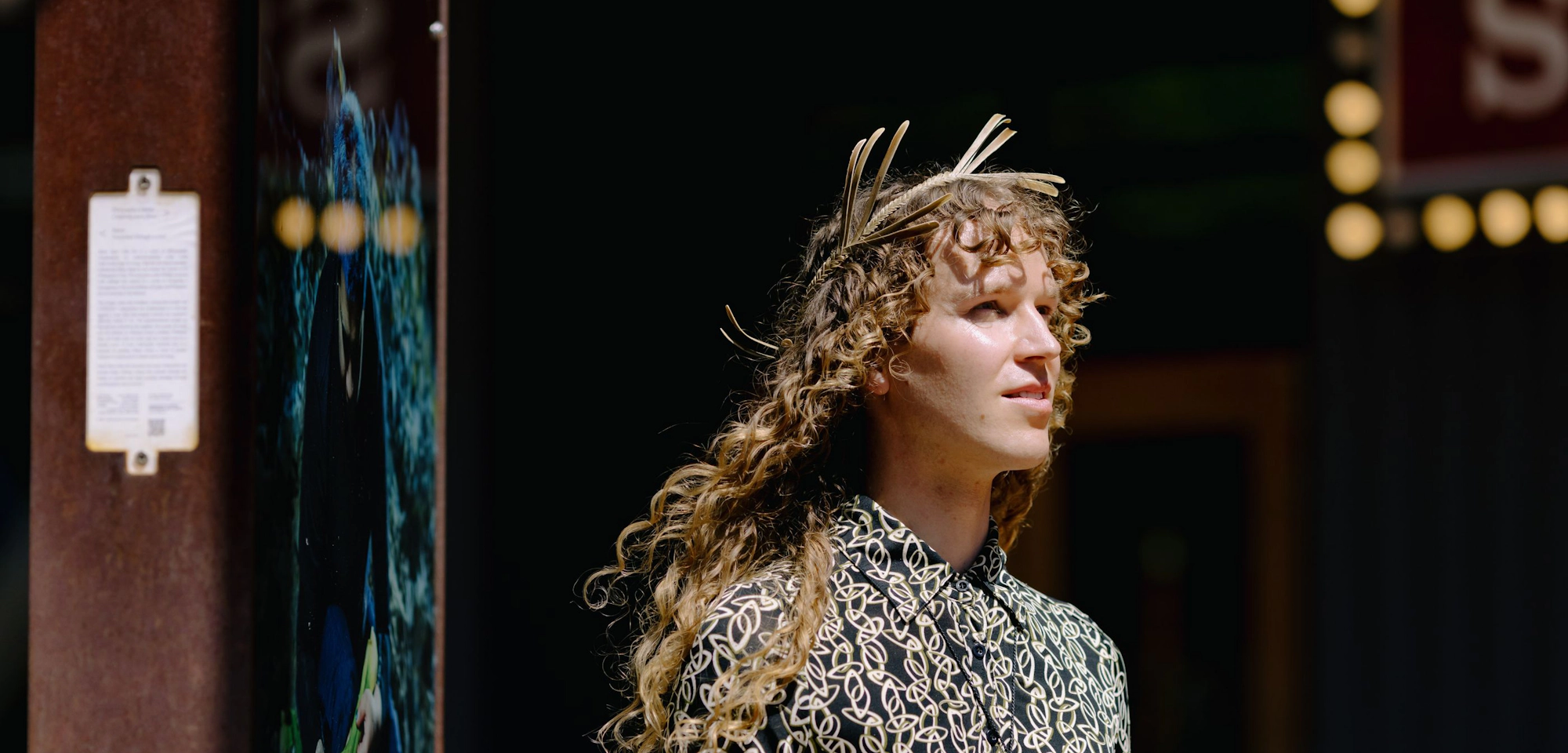
The artists out and about in Hanoi (Photo: Simon Palenski)
That tomorrow will be was the exhibition we put on during the residency; the title coming from the lyrics of a song sung in one of Christopher’s works.
We partnered with Heritage Art Space for this, who helped us secure a venue – a gallery space at the Women’s Museum, and organised the tech and fabrication needed to show the artworks. We had met Nguyễn Anh Tuấn, Heritage’s artistic director, on our curators tour last year.
The space acts as a local hub for residencies, exchanges and programmes that connect Vietnamese artists with peers and other artists and organisations internationally. They also hold an archive and library of Vietnamese art and cultural publications that acts as an independent educational resource.

That tomorrow Will Be exhibition with artworks by Christopher Ulutupu and Georgina May Young (Photo: Sorawit Songsataya)
It was great to be able to reconnect and work on a project with Tuấn and the rest of the Heritage team, and we’re so grateful to them for their support and know-how. It was rewarding after all the opening speeches and ceremonies to see people really engaging with and appreciating Sorawit, Christopher and Georgina’s artworks.
Vietnam is such a culturally rich and storied place, with a distinct art history spanning centuries. Trips like this are such a privilege in this day and age, and I got the sense that all of us are hopeful and eager to return one day.
The Foundation's Arts Programme brings Asia into the mainstream of New Zealand arts by inspiring New Zealand arts professionals to grow their connections and knowledge of Asia. It also supports the presentation of Asian arts in partnership with New Zealand arts organisations and events.