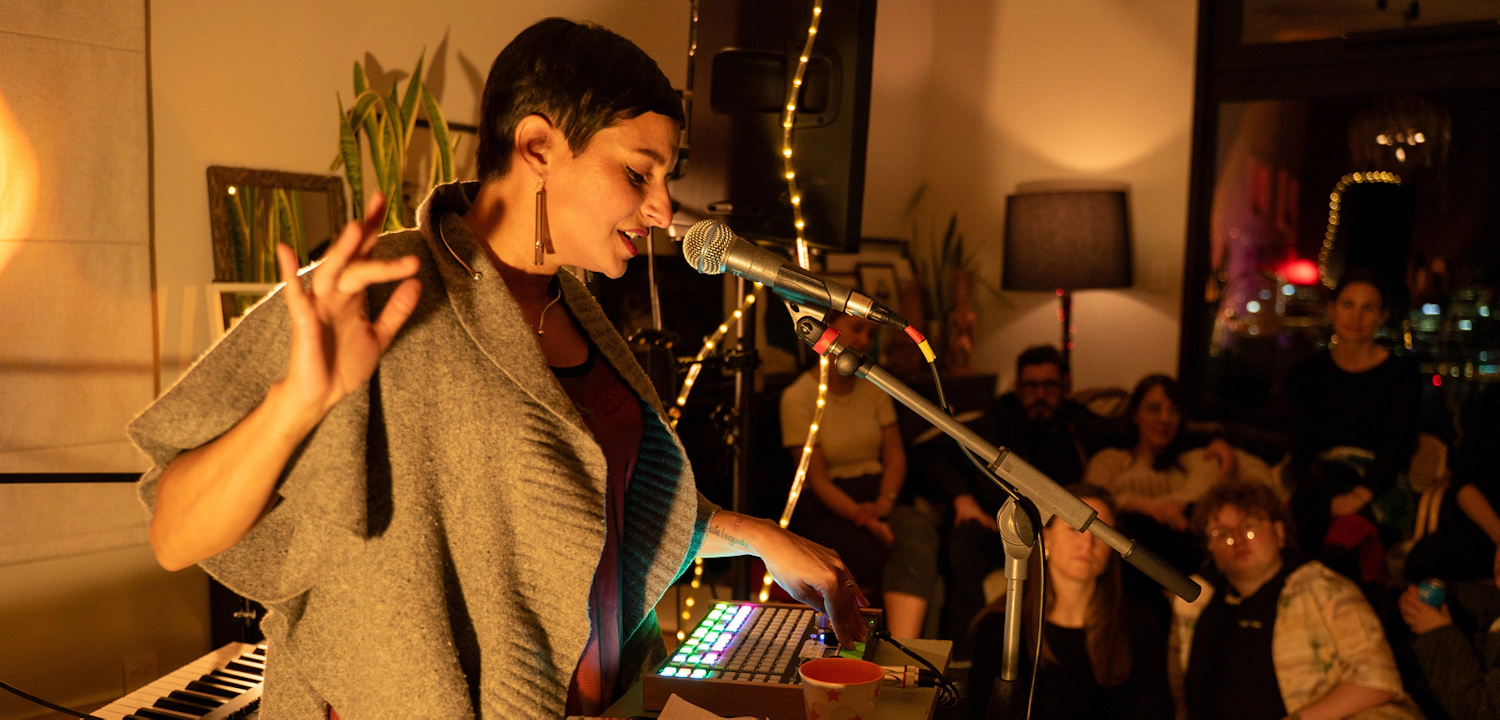
Artist uncovers the hidden story of South Korea’s tī kōuka
Louie Zalk-Neale (Ngāi Te Rangi, Pākehā) is a performance artist and weaver who travelled to Seoul in April 2026 for the inaugural residency offered by McCahon House (Auckland) and the Space for Contemporary Art (Seoul), supported by the Asia New Zealand Foundation and Creative New Zealand. During the residency, Louie connected with local artists and travelled to Jeju Island to learn about the mystery of New Zealand harakeke (flax) and tī kōuka (cabbage trees) growing on the island.


Louie Zalk-Neale (Image: Chantelle Gribbon)
On my first morning waking up in the residency apartment in Jongno District, Seoul, I sat looking up at the quivering bare branches outside. We — my husband, 5-year-old and I — had arrived in the last moments of winter.
Over the coming days those branches sprouted tiny green leaves; stark tohu [signs] of seasonal change that I hadn’t experienced since living in Berlin ten years ago. By the end of the month, they were wide flourishing leaves basking in 25-degree sunshine.
Strangely, there were several chickens roaming below the trees, peacefully clashing with the hyper-digital city around us. That apartment was our home for a month — a place for resting, planning and playing, and a whare where we invited new friends and art colleagues to share kai and kōrero, sometimes with an AI translator mediating our words.
The tohu [sign] that sparked part of my research during this residency was on the cover of a book by the photographer Oksun Kim "The Shining Things".
This book holds a collection of photographs of exotic trees on Jeju-do — a volcanic island south of the Korean Peninsula.
The cover girl is a tī kōuka, endemic to Aotearoa, and the basis of my weaving practice here in Aotearoa.
In the photograph, the tree in the image shares its foothold with a standing rock, which in my imagination holds a strong mauri and must have seen many centuries of change on the island. Jeju-do is an almost-tropical destination, popular with domestic and international tourists.


Left: Louie holding Oksun Kim’s book"The Shining Things" which has a tī kōuka tree on the cover. Right: seeing the Jeju Island tī kōuka trees in the flesh (Images: Yuval Zalk-Neale)
The people of Jeju-do have a long cultural history, which I won't pretend to fully understand, but I sensed the warm manaakitanga of their culture — their strong, knowing connection to the rocky landscape and ocean, and the dark times of occupation from multiple directions.
So I went there to find that tree. My husband drove us (on the correct side of the road) to meet our hosts Seungyeon and Jan at a resort café I'd found online named Harakeke. It felt surreal to see a Māori word on a sign so far from home.
The outdoor grounds of the café were lined with astro-turf, blue swimming pools, Moai sculptures (Rapanui/Easter Island heads) and many references to Bali.
The owners were clearly aiming for a sort of exotic tropical fantasy, which was why the whole area was planted generously with tī kōuka and harakeke.
Their long tropical looking leaves can withstand the cold winter on Jeju-do while maintaining that balmy feel on Instagram snapshots.
But harakeke is not only on the island for its tropical vibes — it has an important but mysterious whakapapa on Jeju Island, perhaps arriving via China because of the name it's known by on the island, shinseoran (literally meaning 'New Zealand'), or shinsara, a Jeju language variation.


During the residency, Louie connected with cultural expert Ko Gwang Min and local harakeke weaver Kang Moon Sil (Image by Jan K. Sim)
Later in the trip I met weaver Kang Moon-Sil, who I spent two days weaving with, and from our kōrero it seems that since at least the 1930s, harakeke was grown as the primary household crop for rope and basketry, superior to the palm fibre (which is also an exotic species), until these craft practices were replaced by industrial plastic towards the end of the century.
After this strange encounter with familiar tipu [plants] in an unfamiliar place, we went to meet the photographer, Oksun Kim, whose portraits of exotic trees had led me here. Many of her portraits are of people in their homes — of foreigners living in Jeju-do, or Koreans living overseas.
The trees, palms, pines, and succulents tell a similar story of the push and pull of living as a migrant.
Oksun hosted us in her apartment and then took us on a walk to see that tree that had me so intrigued.
She told me that in the 80s, South Korea put in place a government directive to make Jeju-do a tourist destination aimed at the Japanese market. A huge change for the hardworking local residents who were used to surviving with little money and minimal infrastructure.
As we walked, Oksun told me not to get my hopes up.


Louie and photographer Oksun Kim in front of the tī kōuka tree that Oksun photographed 12 years earlier (Photo: Jan K. Sim)
We arrived at a roadside carpark where local citrus growers stored equipment. The overgrown area next to was where the tree still stood. It was an abandoned truckstop park, which decades ago, would have been well manicured with its exotic palms, cycads, agave and several tī kōuka.
Since the photo was taken in 2012, the tī kōuka has grown taller but looks in bad health.
Tī kōuka is a very resilient plant and will keep growing back, but as I looked at it, I wondered about it’s strength so far from home — I wondered if the atua [Māori deities] who gave it the ability to adapt to different soils and climates, Ngai-kore-tua-mao and Rewa-taha, had given it the tools to thrive here too.
That basalt mauri stone standing next to it was not what I had romanticised, it was a fake rock made of fiberglass.
Louie Zalk-Neale is a Wellington-based artist and Māori weaver whose practice combines contemporary performance with textile and fibre traditions. Their work explores embodied knowledge, identity and material culture, bridging Indigenous practice and contemporary art contexts.
The McCahon House–Space for Contemporary Art (SCA) Residency forms part of a wider exchange agreement between McCahon House and SCA, under which a Korean artist will be hosted in Titirangi in August 2026 in recognition of the strategic significance of the partnership, and the opportunity to deepen New Zealand–Korea contemporary arts exchange at an institutional level.
The Foundation's arts programme brings Asia into the mainstream of New Zealand arts by inspiring New Zealand arts professionals to grow their connections and knowledge of Asia. It also supports the presentation of Asian arts in partnership with New Zealand arts organisations and events.
The Foundation provided funding to McCahon House, who facilitated Louie's South Korea visit and residency.